How Long Should a CV Be?
Most UK CVs should be one or two pages. One page is usually right for school leavers, students and anyone with limited work history, while two pages suits most people with several years of relevant experience. Longer than two pages is rarely necessary outside academic or highly specialised CVs.
One page vs two pages
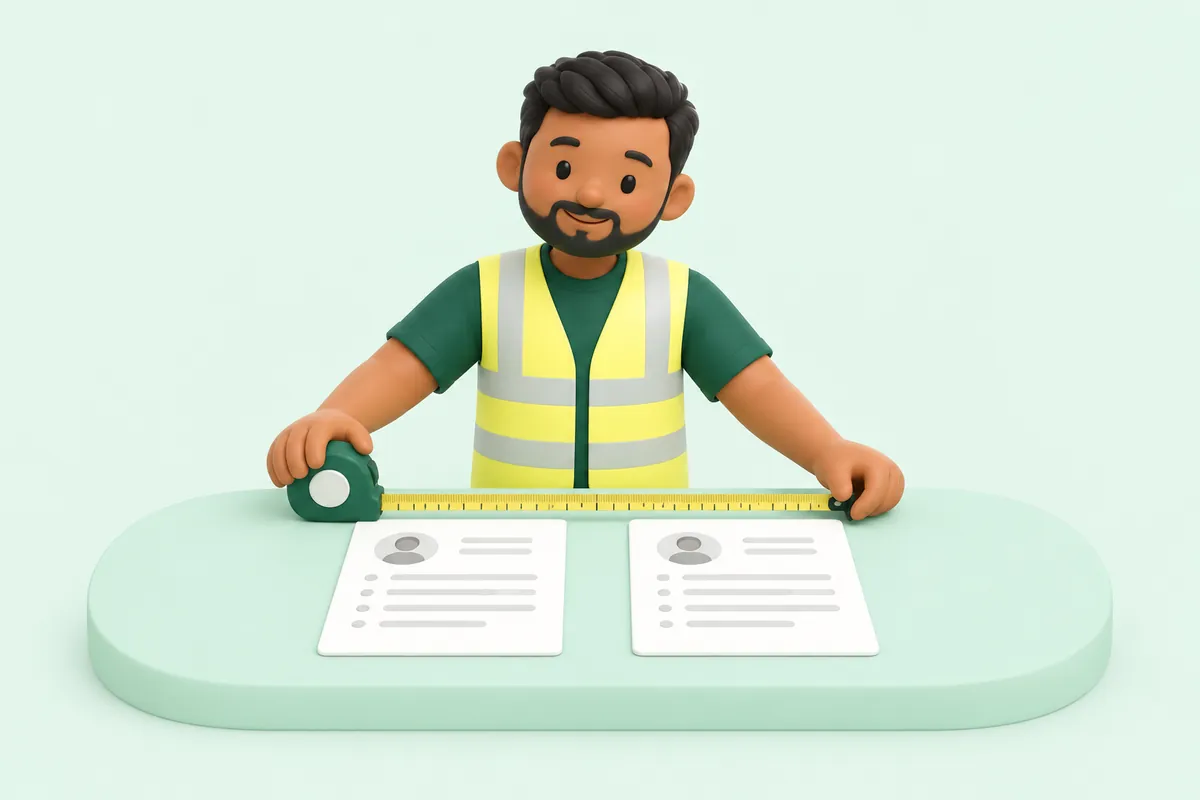
There is no strict rule, but two pages is the practical upper limit for most job applications in the UK. The goal is to include everything relevant and nothing that is not, rather than aiming for a specific page count.
If you can fit a strong CV onto one page without cramming the text or shrinking the font, that is perfectly acceptable, particularly earlier in your career. A well-organised single page is better than a stretched two-page version with large gaps.
Aim to fill each page you use reasonably fully. A CV that runs onto a second page with only two or three lines of content can look unbalanced, and is often better trimmed back to a tidy single page instead.
When one page makes sense
School leavers, students, and people applying for their first or second job usually have less to include, so one page is natural. Trying to stretch this to two pages with padding tends to weaken the CV rather than strengthen it.
If you are in this position, focus your effort on making the one page as clear and specific as possible, rather than worrying that it looks short compared with more experienced candidates.
When two pages makes sense
Once you have several years of relevant work experience, two pages allows enough room to describe your roles properly without cutting useful detail. This is normal for most experienced professionals and is not seen as excessive by UK employers.
The key is to use the extra space for genuinely useful detail about recent, relevant roles, rather than simply listing every task from every job you have ever had.
A second page also gives more room for a fuller skills section or a short additional information section, where relevant, without crowding the work history that usually matters most to a reader.
How to shorten a CV that runs long
Cut detail from older or less relevant roles rather than every role equally. A job from ten years ago rarely needs the same number of bullet points as your current one.
Remove repeated skills, generic statements, and any section that does not support the specific job you are applying for. If two bullet points say roughly the same thing, keep the stronger one and cut the other.
It can help to print your CV out, or view it exactly as it will appear as a document, since it is often easier to spot where a page is running long or feeling crowded this way than on screen.
- Trim bullet points for older roles to one or two lines each
- Remove a hobbies section if space is tight
- Cut duplicate skills that appear in more than one section
- Tighten your personal statement to the essentials
What not to cut
Do not shorten your CV by removing dates, employer names, or enough detail that a reader cannot tell what you actually did in a role. Length should come down by cutting weak or repetitive content, not important facts that help a reader assess your application fairly.
Similarly, resist the urge to shrink your font size or margins drastically just to force everything onto fewer pages, since a cramped, hard-to-read page is usually worse than a slightly longer, more readable one.
Judging length by content, not by rule
Rather than deciding on a page count first and writing to fit it, write out everything genuinely relevant, then see how much space it takes up. Most people find this naturally lands around one or two pages once weak or repetitive content has been removed.
If your CV runs noticeably longer than two pages even after a careful edit, it is worth checking whether every role and every bullet point is still earning its place, rather than assuming the extra length is simply because you have more experience than most.
This content-first approach tends to produce a more natural, better-balanced CV than starting with a fixed page target and stretching or squeezing the content to fit it.
How length can change over your career
It is normal for a CV to grow gradually as your career progresses, then get trimmed back down periodically as older material is condensed. Revisiting your CV every year or two, even when you are not actively job hunting, makes this easier to manage than trying to cut a decade of unedited detail all at once.
Keeping a longer master version alongside a trimmed application version, as described in the guide to tailoring a CV, makes this process easier, since you always have the fuller detail available to draw on when needed.